
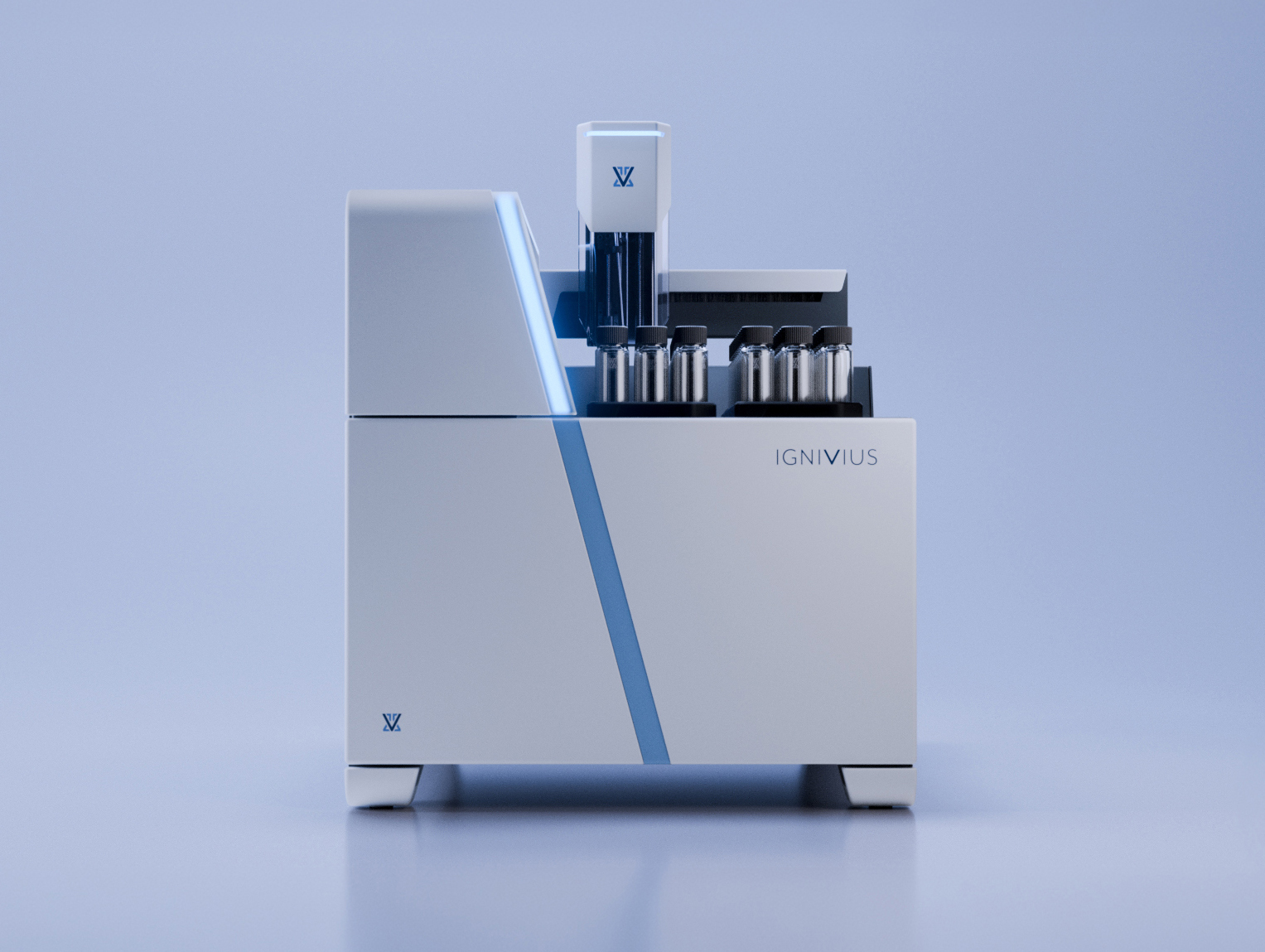
IGNIVIUS TOC/TNb Analyzer – Next-Generation Automated Analysis by Skalar
IGNIVIUS is an automated liquid analyzer for Total Organic Carbon and Total Bound Nitrogen analysis. It combines high-temperature catalytic combustion, direct sample injection and intelligent automation to support reliable, high-throughput analysis of TC, TIC, TOC, NPOC, POC and DOC, with optional TNb detection.
Developed through a collaboration between Skalar and TRACE, two Velaris organizations with decades of experience in combustion-based TOC analysis, IGNIVIUS is designed for modern environmental, chemical, energy and process laboratories that require reliable results, high sample throughput and reduced operator intervention.
What is the IGNIVIUS analyzer?
IGNIVIUS is a combustion-based analyzer designed to determine carbon parameters and Total Bound Nitrogen in liquid samples. The system is intended for laboratories that need to process large sample batches while maintaining consistent analytical workflows and minimizing manual handling.
The analyzer combines three principal elements:
- High-temperature catalytic combustion for converting carbon- and nitrogen-containing components into detectable gases.
- A highly sensitive NDIR detector for carbon measurement.
- Optional CLD detection for Total Bound Nitrogen analysis.
IGNIVIUS is designed to automate more than the final measurement. Its workflow covers direct sample introduction, NPOC pretreatment, inorganic carbon removal, inline dilution, sample handling and instrument status communication.
Supported carbon and nitrogen parameters
The IGNIVIUS TOC/TNb analyzer supports several analytical modes for environmental monitoring, quality control and industrial process applications.
| Parameter | Full name | Analytical meaning |
|---|---|---|
| TC | Total Carbon | The total amount of carbon present in the sample. |
| TIC | Total Inorganic Carbon | The carbon present in inorganic forms within the sample. |
| TOC | Total Organic Carbon | The organic carbon content used to assess organic loading in water and process streams. |
| NPOC | Non-Purgeable Organic Carbon | The organic carbon remaining after acidification and sparging pretreatment. |
| POC | Purgeable Organic Carbon | The fraction of organic carbon that can be removed from the sample by purging. |
| DOC | Dissolved Organic Carbon | The organic carbon contained in the appropriately treated dissolved sample fraction. |
| TNb | Total Bound Nitrogen | Total bound nitrogen analysis available with the optional CLD configuration. |
By supporting multiple carbon parameters on one platform, IGNIVIUS can be configured for applications ranging from drinking water and wastewater analysis to raw-material testing, production monitoring and the control of cooling water, condensate and industrial process streams.
How does the IGNIVIUS TOC/TNb analyzer work?
IGNIVIUS uses high-temperature catalytic combustion. A liquid sample is introduced directly into the combustion zone, where carbon-containing compounds are oxidized to form carbon dioxide.
The carbon dioxide produced during combustion is measured using a non-dispersive infrared detector. The detector signal is processed by the instrument software to determine the applicable carbon parameter.
When equipped with the optional TNb configuration, nitrogen-containing compounds are converted during combustion and measured by CLD detection. This allows carbon and Total Bound Nitrogen analysis to be performed on the same instrument platform.
The direct injection design simplifies the sample pathway and supports the analysis of real-world sample matrices, including samples containing suspended particles.
Key technologies of the IGNIVIUS TOC/TNb analyzer
1. Direct Injection Technology
IGNIVIUS transfers the sample directly into the combustion zone instead of moving it through a conventional flow-through sample-transfer pathway.
This design provides several practical benefits:
- Improved handling of particle-containing samples.
- A simplified sample flow path.
- Lower risk of clogging and contamination.
- Reduced carry-over through efficient rinsing.
- Suitability for small sample volumes.
- Lower maintenance requirements.
- Improved system reliability and laboratory uptime.
Direct injection is particularly valuable for wastewater, surface water and industrial process samples that may contain suspended material or complex matrices.
2. Parallel NPOC Pretreatment
NPOC analysis normally requires the sample to be acidified and sparged before measurement. IGNIVIUS performs the pretreatment of the next sample while the current sample is being analyzed.
While one sample is in the measurement cycle, the following sample is already being acidified and sparged. This parallel workflow helps laboratories to:
- Reduce idle time between samples.
- Increase sample throughput.
- Shorten result turnaround times.
- Support long unattended sequences.
- Maximize analyzer utilization.
- Improve overall laboratory productivity.
IGNIVIUS combines Direct Injection Technology and parallel NPOC pretreatment within one platform, providing both robust particle handling and high-throughput NPOC analysis.
3. Smart Sparging Technology
Reliable NPOC results depend on the effective removal of inorganic carbon. Instead of assuming that inorganic carbon has been removed after a fixed pretreatment period, IGNIVIUS verifies the residual IC level.
Smart Sparging Technology automatically extends or adjusts the sparging time whenever necessary. This helps provide:
- Verification of inorganic carbon removal.
- Improved NPOC reproducibility.
- Reduced operator dependency.
- Automatic optimization of sparging conditions.
- Documented proof of pretreatment effectiveness.
- More reliable NPOC measurements.
4. Integrated Inline Dilution
IGNIVIUS performs dilution during sample pickup. Dedicated dilution vessels do not need to occupy positions in the sample rack.
Integrated inline dilution offers several workflow advantages:
- No dedicated rack positions are required for dilution.
- More sample positions remain available.
- Calibration can be prepared from a single stock standard.
- Over-range samples can be diluted automatically.
- Manual sample preparation is reduced.
- Consistency and accuracy are improved.
High sample capacity and unattended operation
IGNIVIUS is designed for laboratories with demanding daily workloads. Depending on the vial configuration, the analyzer can accommodate:
- Up to 170 × 8 ml vials.
- Up to 96 × 24 ml vials.
- Up to 66 × 40 ml vials.
The large sample capacity reduces the frequency of rack loading and supports extended sequences, overnight operation and increased daily sample throughput.
Smart LED status indication
The integrated LED indicator communicates instrument status at a glance:
- Blue: the analyzer is ready to run or a run is in progress.
- Green: results are ready for review.
- Yellow: user attention is required.
- Red: the run has stopped and user action is required.
This visual status system allows laboratory personnel to monitor the analyzer from a distance, which is useful in facilities operating several instruments simultaneously.
Applications of the IGNIVIUS TOC/TNb analyzer
Environmental and water analysis
- Drinking water.
- Surface water.
- Groundwater.
- Municipal and industrial wastewater.
- Monitoring organic carbon through water-treatment processes.
Chemical industry
- Production monitoring.
- Raw-material analysis.
- Process-stream monitoring.
- Quality control of liquid samples.
Energy and industrial utilities
- Cooling-water analysis.
- Condensate monitoring.
- Process-stream analysis.
- Water-quality monitoring in energy and circulation systems.
The appropriate TOC, NPOC, DOC or TNb configuration should be selected according to the sample matrix, expected concentration, analytical objective and standard method used by the laboratory.
Benefits of IGNIVIUS for modern laboratories
| Laboratory requirement | IGNIVIUS solution |
|---|---|
| Higher sample throughput | Parallel NPOC pretreatment, automated workflows and high sample capacity. |
| Analysis of particle-containing samples | Direct sample injection with a simplified sample pathway. |
| Reduced carry-over | Efficient rinsing and fewer complex sample-transfer components. |
| Reliable NPOC pretreatment | Smart Sparging verifies residual inorganic carbon and adjusts sparging time. |
| Less manual dilution | Integrated dilution during sample pickup. |
| Long unattended operation | Up to 170 positions for 8 ml vials and automated sample processing. |
| Easy instrument monitoring | Multi-color LED status indication. |
By combining intelligent automation, combustion technology and robust engineering, IGNIVIUS helps laboratories increase productivity while maintaining a consistent analytical workflow.
When should a laboratory consider IGNIVIUS?
IGNIVIUS is suitable for laboratories that:
- Process a high number of samples each day.
- Frequently perform NPOC analysis.
- Analyze particle-containing or complex liquid samples.
- Want to reduce manual acidification, sparging and dilution.
- Require long analytical sequences with limited operator intervention.
- Need carbon and optional TNb analysis on one platform.
The final instrument configuration should be selected according to the sample type, concentration range, daily workload, TNb requirements and analytical methods used by the laboratory.
Frequently asked questions about IGNIVIUS
Which parameters can IGNIVIUS analyze?
IGNIVIUS supports TC, TIC, TOC, NPOC, POC and DOC analysis. Total Bound Nitrogen analysis is available as an optional configuration.
Which analytical principle does IGNIVIUS use?
IGNIVIUS uses high-temperature catalytic combustion. Carbon is measured using an NDIR detector, while optional TNb analysis is performed using CLD detection.
Can IGNIVIUS analyze samples containing particles?
Yes. Direct Injection Technology is designed to improve particle handling while reducing the risk of clogging, contamination and sample carry-over.
What does Smart Sparging Technology do?
Smart Sparging checks residual inorganic carbon after NPOC pretreatment and automatically adjusts the sparging time when additional IC removal is required.
Can IGNIVIUS dilute samples automatically?
Yes. Integrated Inline Dilution performs dilution during sample pickup and can automatically dilute over-range samples.
How many samples can the IGNIVIUS sample rack accommodate?
Depending on the vial configuration, IGNIVIUS can accommodate up to 170 × 8 ml vials, 96 × 24 ml vials or 66 × 40 ml vials.
Request an IGNIVIUS TOC/TNb analyzer configuration
Every TOC and TNb application may require a different instrument configuration, analytical mode and sample-handling workflow. Before selecting a system, laboratories should identify the sample matrix, required parameters, expected concentration range, daily sample volume and applicable analytical methods.
Contact 2H Instrument for assistance in selecting an IGNIVIUS configuration for environmental, water, chemical, energy and industrial process applications.





Reviews
There are no reviews yet.